1Shanghai Jiao Tong University
2Department of Computer Science, Rutgers University–New Brunswick
3Nanyang Technological University
4The Hong Kong University of Science and Technology (GZ)
5Shanghai AI Laboratory
*Equal contribution. †Corresponding authors.
Corresponding Authors: Gen Li, Jingjin Yu
Project Leaders: Yifan Han, Litao Liu
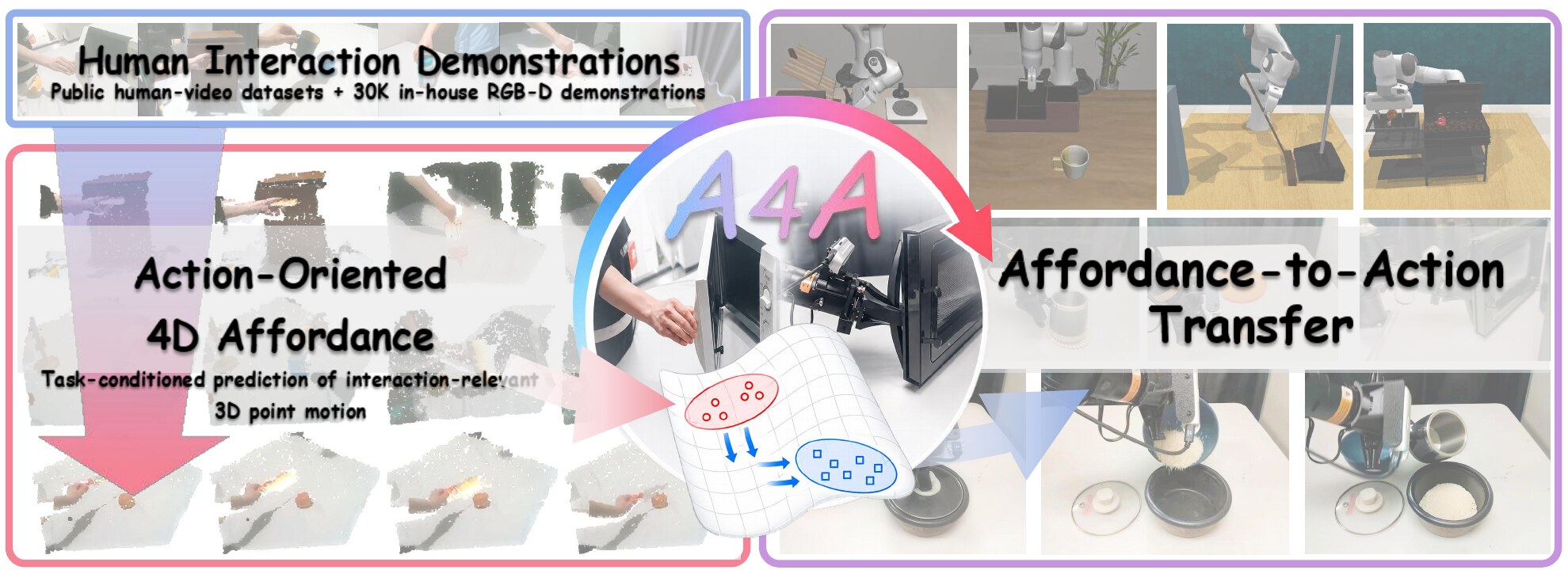
Human demonstrations contain rich manipulation knowledge, but it remains unclear what information can be transferred effectively to robot control. Existing affordance representations are typically formulated as 2D masks, 3D regions, contact points, or actionability scores, and therefore primarily identify where interaction may occur. However, effective manipulation also requires modeling how interaction-relevant geometry evolves during task execution. To bridge this gap, we introduce action-oriented 4D affordances, which represent the language-conditioned future trajectories of interaction-relevant 3D points. These trajectories capture task-conditioned geometric evolution rather than embodiment-specific actions, enabling transferable interaction priors across humans and robots. Based on this representation, we construct a large-scale action-oriented 4D affordance dataset from existing human–object interaction video data and complementary RGB-D demonstrations, and introduce A4A, an affordance-to-action framework that uses 4D affordance trajectory prediction to pretrain robot policies before manipulation finetuning. Experiments in both simulation and the real world validate the effectiveness of A4A, showing that pretraining with action-oriented 4D affordance data consistently improves the manipulation performance of diverse VLA policies. These results establish action-oriented 4D affordances as an effective cross-embodiment representation for transferring manipulation knowledge from human demonstrations to robot control.
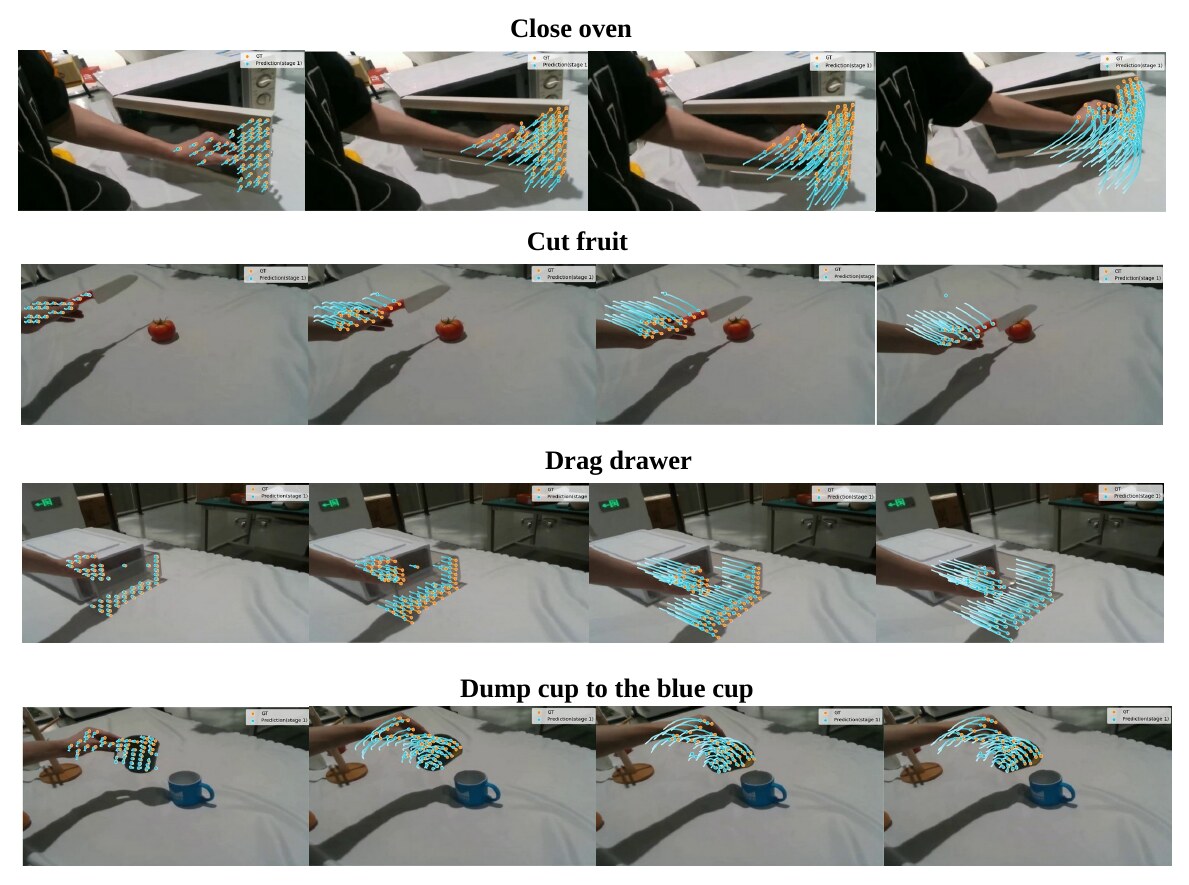
A task-conditioned representation of the future evolution of interaction-relevant 3D geometry captured from human demonstrations. Unlike static affordance localization, it characterizes how an interaction should unfold, providing a transferable, action-aligned supervision signal across embodiments.
A cross-embodiment framework that uses 4D point trajectories as the pretraining prediction space of VLA policies, then adapts the learned representation to robot control through each policy's native state and action interfaces — no extra temporal network is introduced.
Evaluated across five VLA policy families, simulated manipulation benchmarks, and real-world tasks: consistent gains for autoregressive, regression, diffusion, and flow-matching policies, strong RGB-only results against methods that explicitly consume 3D or 4D observations, and more effective transfer than generic scene-wide 4D pretraining.
Over a short horizon, end-effector motion and the 4D motion of interaction-relevant local points are two geometric descriptions of the same manipulation transition. A4A turns that correspondence into a pretraining objective.
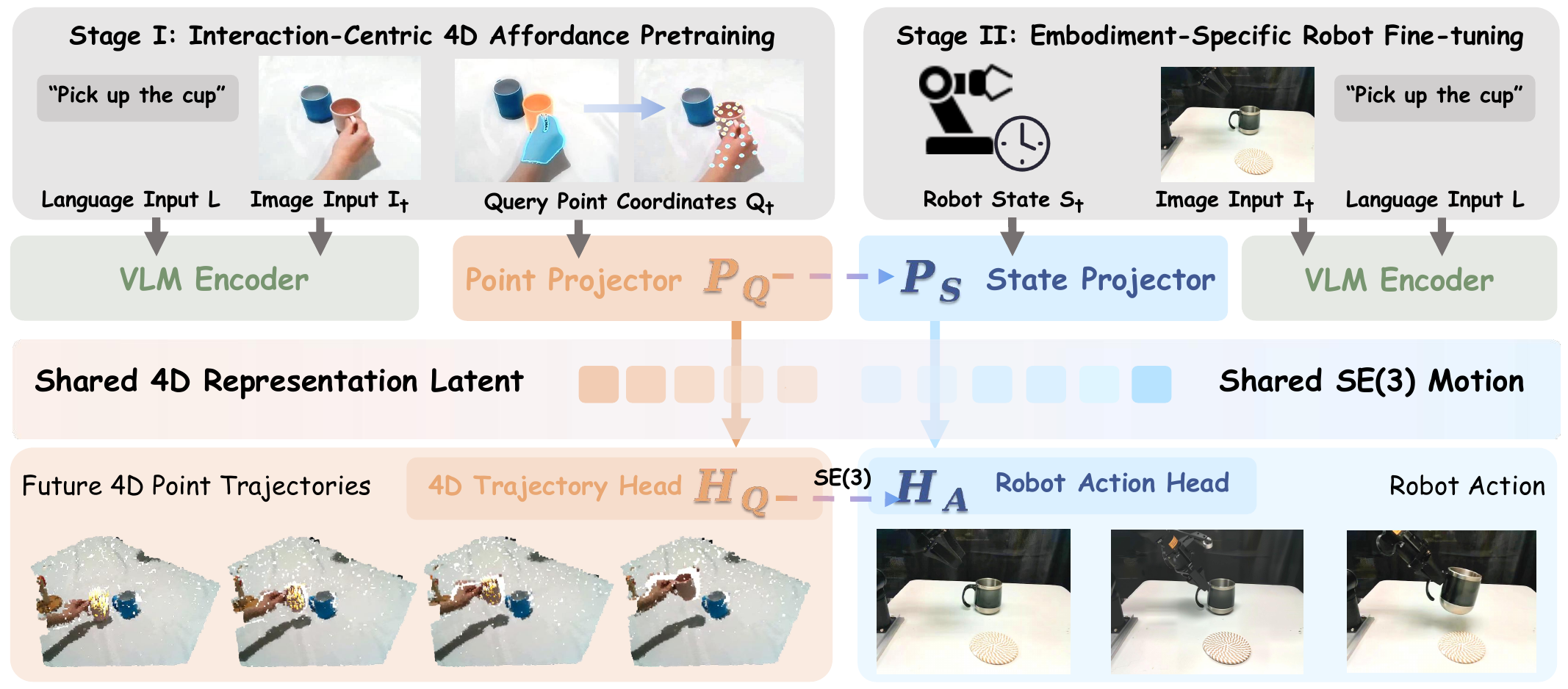
A point projector PQ maps interaction-relevant query-point coordinates into the policy's state-token space; the shared latent module Fθ consumes them alongside the native vision–language features, and the head HQ predicts future point motion, parameterized as a residual over constant velocity.
The transition to robot control is localized to the external interfaces: PQ → PS and HQ → HA. The vision–language stack and the shared latent parameters Fθ are preserved across both stages.
Each base policy keeps its own objective family, applied to valid 4D point targets: token cross-entropy for OpenVLA, continuous regression for OpenVLA-OFT, DDPM denoising for Octo, and flow matching for π0 and π0.5 — so pretraining and control share one prediction mechanism.
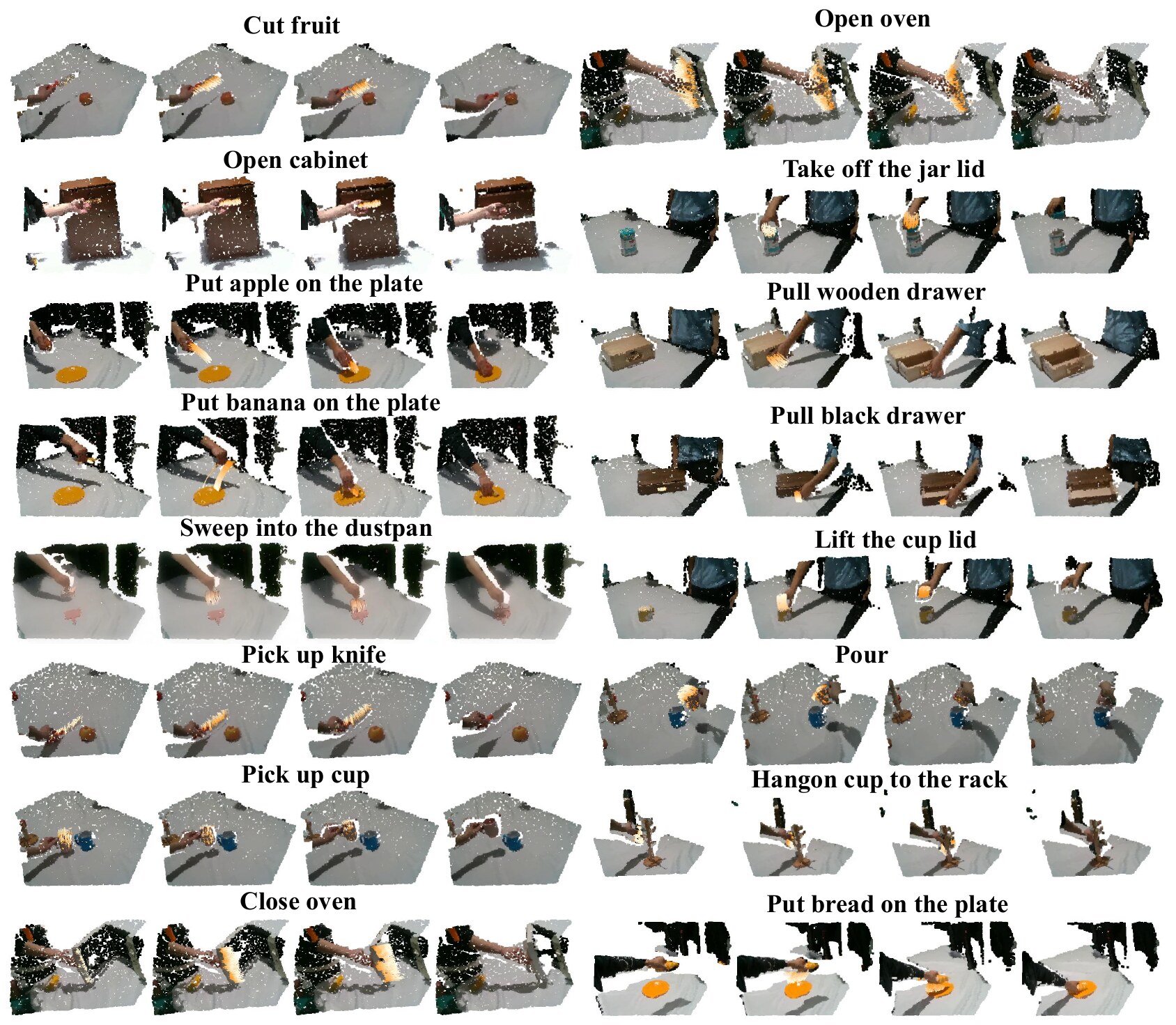
Over 80K interaction clips in total, built from HOI4D and EPIC-KITCHENS together with roughly 30K in-house RGB-D demonstrations. Clips from the public datasets are processed using their existing interaction annotations — reconstructed directly in 3D where reliable depth, object poses, or 3D labels are available, and otherwise lifted from image-space tracks with estimated depth and camera-motion compensation. For the in-house subset, query points are localized with GroundingDINO + SAM 2, tracked with CoTracker3, and back-projected to metric 3D using LingBot-refined depth. Both routes yield identity-preserving 3D point trajectories.
Per-task success rate (%) on LIBERO-Object. Each task picks up the named object and places it in the basket. In every pair, A4A pretraining is the only variable.
| Object | Octo | OpenVLA | OpenVLA-OFT | π0 | π0.5 | ||||||||||
|---|---|---|---|---|---|---|---|---|---|---|---|---|---|---|---|
| Base | A4A | Δ | Base | A4A | Δ | Base | A4A | Δ | Base | A4A | Δ | Base | A4A | Δ | |
| Alphabet soup | 36 | 64 | +28 | 76 | 88 | +12 | 100 | 100 | 0 | 76 | 88 | +12 | 100 | 100 | 0 |
| Cream cheese | 20 | 56 | +36 | 68 | 78 | +10 | 98 | 98 | 0 | 86 | 92 | +6 | 90 | 94 | +4 |
| Salad dressing | 30 | 68 | +38 | 84 | 92 | +8 | 98 | 98 | 0 | 86 | 94 | +8 | 100 | 98 | −2 |
| BBQ sauce | 16 | 36 | +20 | 42 | 54 | +12 | 98 | 100 | +2 | 56 | 78 | +22 | 84 | 92 | +8 |
| Ketchup | 12 | 48 | +36 | 74 | 86 | +12 | 100 | 98 | −2 | 88 | 92 | +4 | 100 | 100 | 0 |
| Tomato sauce | 38 | 58 | +20 | 58 | 74 | +16 | 100 | 100 | 0 | 72 | 86 | +14 | 96 | 98 | +2 |
| Butter | 18 | 38 | +20 | 62 | 68 | +6 | 98 | 100 | +2 | 88 | 96 | +8 | 92 | 96 | +4 |
| Milk | 14 | 56 | +42 | 78 | 84 | +6 | 100 | 100 | 0 | 62 | 74 | +12 | 84 | 88 | +4 |
| Chocolate pudding | 54 | 72 | +18 | 56 | 62 | +6 | 88 | 94 | +6 | 90 | 96 | +6 | 100 | 96 | −4 |
| Orange juice | 44 | 76 | +32 | 66 | 78 | +12 | 100 | 98 | −2 | 74 | 82 | +8 | 94 | 98 | +4 |
| Average | 28.2 | 57.2 | +29.0 | 66.4 | 76.4 | +10.0 | 98.0 | 98.6 | +0.6 | 77.8 | 87.8 | +10.0 | 94.0 | 96.0 | +2.0 |
The five policies span diffusion (Octo), discrete autoregressive generation (OpenVLA), continuous regression (OpenVLA-OFT), end-to-end flow matching (π0), and hierarchical flow matching (π0.5). A4A improves the average success rate of every policy; the smaller gains for OpenVLA-OFT and π0.5 are consistent with their already high baselines of 98.0% and 94.0%.
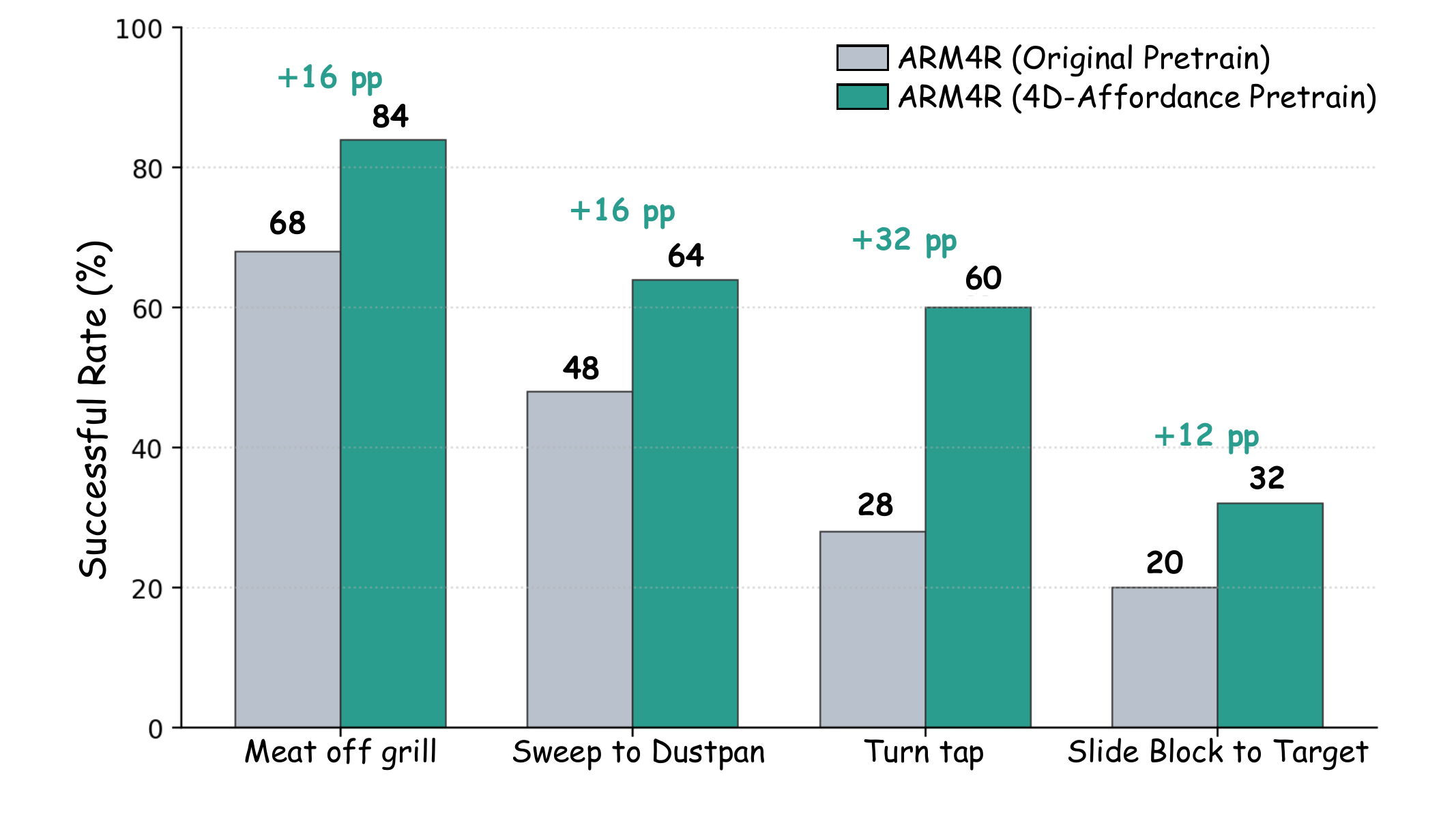
Success rate (%) on four RLBench tasks. Our RGB-only policy is compared against methods that consume explicit 3D or 4D observations. Comparison numbers are quoted from prior work, except ARM4R, which we finetune ourselves from its released stage-one weights.
| Method | Meat | Sweep | Turn Tap | Slide | Avg. |
|---|---|---|---|---|---|
| Image-BC (ViT) | 0.0 | 0.0 | 16.0 | 0.0 | 4.0 |
| C2FARM-BC | 20.0 | 0.0 | 68.0 | 16.0 | 26.0 |
| ManiGaussian | 60.0 | 64.0 | 56.0 | 24.0 | 51.0 |
| ARM4R | 68.0 | 48.0 | 28.0 | 20.0 | 41.0 |
| Ours w/o pretrain | 56.0 | 44.0 | 44.0 | 12.0 | 39.0 |
| Ours w/ pretrain | 88.0 | 60.0 | 68.0 | 28.0 | 61.0 |
| Δ | +32.0 | +16.0 | +24.0 | +16.0 | +22.0 |
Meat, Sweep, Turn Tap, and Slide denote meat off grill, sweep to dustpan, turn tap, and slide block to target. Δ is the gain from 4D affordance pretraining. Without any explicit 3D observation at execution time, the pretrained RGB policy is best on meat off grill and slide block to target, and matches the best result on turn tap.
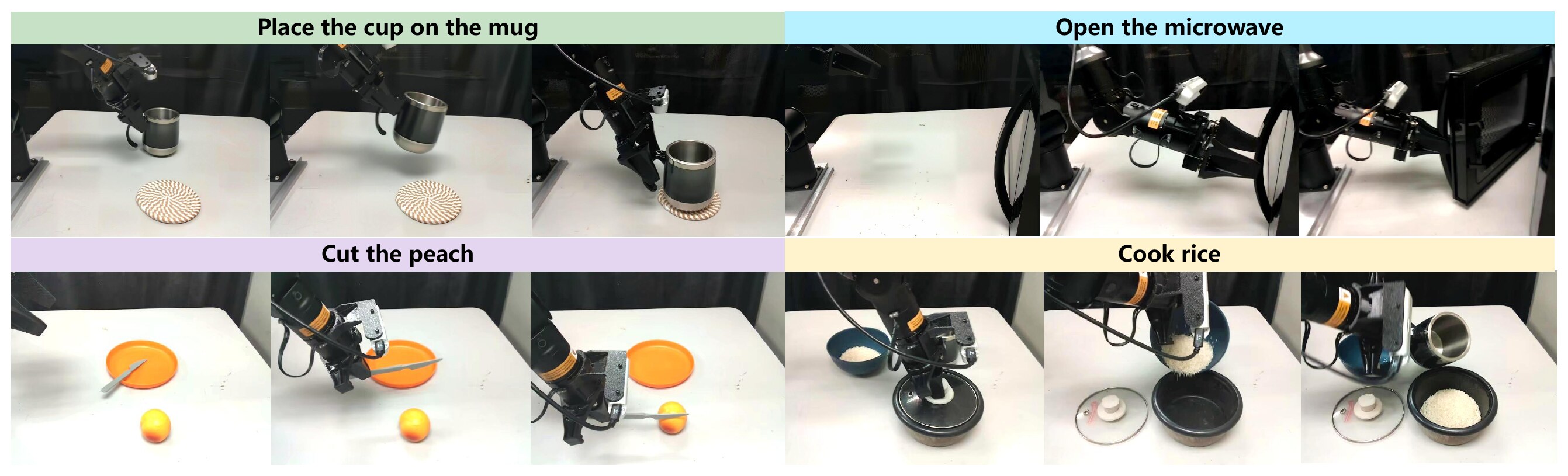
A4A policies deployed on a physical AgileX Piper arm. 100 teleoperated demonstrations per skill; 10 rollouts per skill at evaluation.
Cook rice is trained as three independent skills, each evaluated separately.
Success on the physical Piper arm — successful trials out of 10.
| Method | Microwave | Cup | Peach | Cook Rice | Avg. | ||
|---|---|---|---|---|---|---|---|
| Pot | Rice | Water | |||||
| Octo | 7/10 | 3/10 | 3/10 | 2/10 | 4/10 | 3/10 | 36.7% |
| + A4A | 8/10 | 5/10 | 6/10 | 5/10 | 6/10 | 6/10 | 60.0% |
| OpenVLA | 6/10 | 6/10 | 4/10 | 3/10 | 6/10 | 4/10 | 48.3% |
| + A4A | 9/10 | 6/10 | 7/10 | 5/10 | 7/10 | 7/10 | 68.3% |
| OpenVLA-OFT | 9/10 | 7/10 | 7/10 | 5/10 | 8/10 | 7/10 | 71.7% |
| + A4A | 9/10 | 8/10 | 9/10 | 6/10 | 8/10 | 8/10 | 80.0% |
| π0.5 | 9/10 | 8/10 | 7/10 | 5/10 | 7/10 | 6/10 | 70.0% |
| + A4A | 9/10 | 9/10 | 9/10 | 7/10 | 8/10 | 7/10 | 81.7% |
Incorporating action-oriented 4D affordances improves every policy, raising the mean success rate across all four from 56.7% to 72.5%. Clear improvements are observed on pouring rice and pouring water, where execution requires coordinated object translation together with substantial orientation change — exactly the rotational structure the 4D representation carries over from human demonstrations.
@article{han2026a4a,
  title   = {A4A: Cross-Embodiment Transfer of Action-Oriented 4D
             Affordances from Human Demonstrations},
  author  = {Han, Yifan and Liu, Litao and Gu, Yuqi and Lu, Ye and
             Wang, Hanqing and Wai, Sidney and Myrie, Ishaan and
             Zhang, Qi and Yu, Jingjin and Li, Gen},
  year    = {2026}
}